
Applied TFP
The goal of Applied TFP is to extend the influence of TFP theory and practice as a way of thinking about and treating patients beyond a limited group (patients with BPD based on DSM-5 criteria) and beyond the particular form of treatment (TFP-E) for which it was originally developed.
“There are not enough clinicians trained in evidence-based therapies for borderline personality disorder and other presentations of severe personality disorder. While we continue to refine our focus on extended individual psychotherapy, 'Applied TFP' allows us to bring our experience and knowledge to a broader sphere, fulfilling a crucial role in public health from our 'bottom-up' approach.” John Clarkin (Foundations of Transference-Focused Psychotherapy, Applications in Psychiatric and Medical Contexts, 2024).
Transference-Focused Psychotherapy was created for the treatment of personality disorders in the 70s and 80s, remaining a highly useful outpatient psychotherapy to this day, particularly in contexts where variables of accessibility to highly trained professionals, cost, and time (high frequency) converge.
Today, we face a high volume of patients presenting with personality disorders, leading to significant economic and health service costs for countries (emergency care, hospitalizations, sick leaves, disability, among others). Most of these patients lack access to pertinent diagnosis and treatment; difficult access to specialized care in health systems, high costs in professional training and treatment, coupled with the lack of time and the fast pace of modern life, have led to the emergence of more flexible care modalities with greater impact and lower costs.
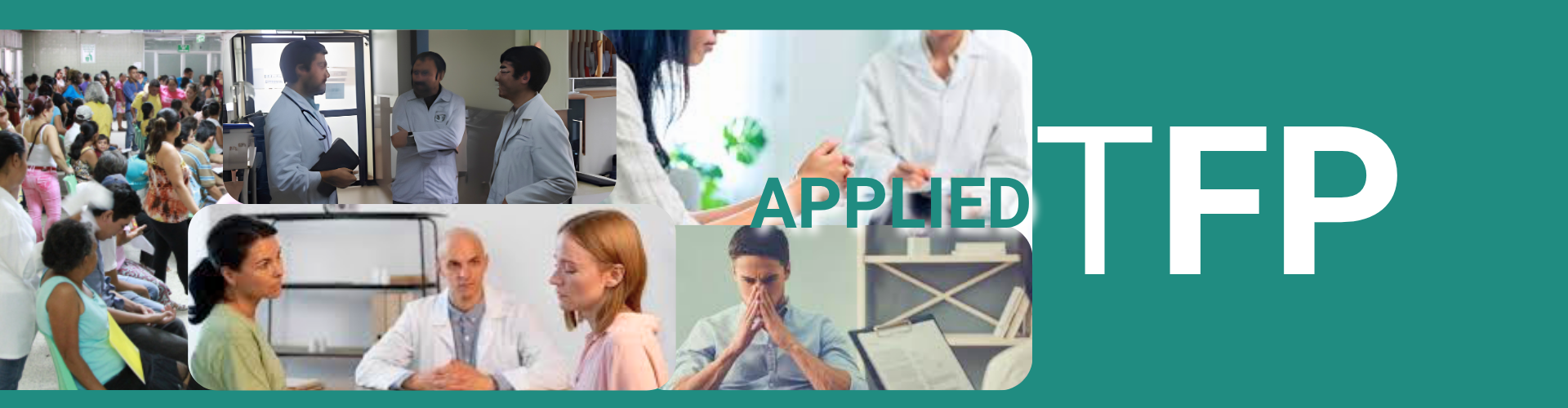
Based on the above, TFP has expanded into other healthcare settings, bringing the essential elements of TFP to work with: adolescents, families, couples, groups, and various clinical contexts (liaison psychiatry, emergency, hospitalization, and pharmacotherapy).
In 2016, the first Applied TFP book emerged: Foundations of Transference-Focused Psychotherapy: Applications in Psychiatric and Medical Contexts - R. Hersh, E. Caligor, F. Yeomans. Its objective was to place the essential elements of TFP at the service of the broad demand for care presented by patients with personality disorders in various health contexts and for various mental health professionals. In 2024, the second book emerged: Implementing Transference-Focused Psychotherapy Principles: General Psychiatric Management for Personality Disorders - R. Hersh, C. De Panfilis. This work demonstrates the implementation of TFP principles in different public health contexts—both outpatient and inpatient—across various countries.
Most psychiatrists, psychologists, and social workers will encounter patients with personality disorders throughout their careers. All clinicians working in adult inpatient and emergency contexts will have the experience of evaluating and treating patients with personality disorders. Likewise, patients with serious personality disorders will present for care in a wide variety of contexts for a wide variety of reasons (not limited to those of a personality disorder) before a broad range of clinicians.
In this way, technical aspects such as the structural interview (STIPO), family involvement in the diagnostic phase and throughout treatment, the possibility of communicating with other treatment providers, discussion of the diagnosis, goals and objectives, the contract, and "TFP strategies"—meaning the understanding of what occurs in the clinician-patient relationship (transference-countertransference) in terms of object relations (self-affect-object), referring to the split the patient experiences in their identity and perception of others—become fundamental and priority aspects in an initial approach and intervention with a patient.
This initial approach can take place in so-called "fast settings": emergency, hospitalization, liaison psychiatry, and pharmacotherapy. Following this initial contact, the patient can be referred to outpatient treatment or "slow settings": individual, couple, or group therapy, where work on these technical aspects will continue, adding others more specific to each type of treatment. Some technical aspects will be more useful in the course of extended individual psychotherapy while others will have broader application.

Elements that require monitoring throughout treatment in Applied TFP
- Orientation toward personal goals and treatment objectives.
- Attention directed at the 3 communication channels (verbal, non-verbal, countertransference). There is a fourth communication channel proposed by Dr. Luis Valenciano, which refers to what the patient is "doing" to the therapist, related to action and intention.
- Identification of the affectively dominant material during each session.
- Continuous attention to the treatment frame and exploration of challenges to the setting as they emerge.
- Continuous refinement of the identification of the dominant object relations dyad, taking role reversal into consideration.
- Use of clarification, confrontation, and (eventually) interpretation to expand upon the material offered by the patient and to engage the patient by offering speculations (hypotheses) about the unconscious process.
- Maintaining a neutral stance, unless some aspect of behavior requires a deviation from this neutrality.
- Speculation about contemporary dyads and the interaction between dyads—more specifically, the ways in which a dyad on the surface might be enveloping a coexisting dyad that could be more threatening or less tolerable.
Ultimately, expanding the TFP approach for personality disorders to intervene in other healthcare settings increases detection and coverage of this pathology, helps reduce stigma through the education of healthcare workers, patients, and their families, and finally, serves as a "gateway" to various outpatient treatments.
Ultimately, expanding the TFP approach for personality disorders to intervene in other healthcare settings increases detection and coverage of this pathology, helps reduce stigma through the education of healthcare workers, patients, and their families, and finally, serves as a "gateway" to various outpatient treatments.